What Credit Score Do You Need to Buy a House in 2026?
One of the most common questions homebuyers ask is: What credit score do I need to qualify for a mortgage?
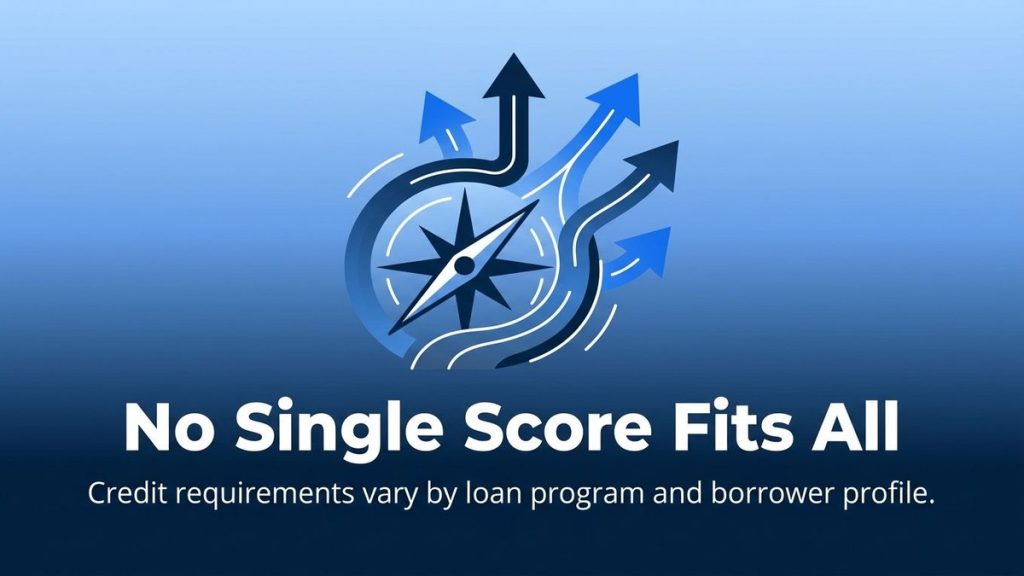
The answer depends on the loan program, your overall financial profile, and sometimes the lender itself. There is no single credit score requirement that applies to every mortgage.
Your credit score can affect more than whether you qualify. It can also influence your interest rate, mortgage insurance, down payment options, and overall loan cost.
Here is a simple breakdown of how credit score requirements generally work across the most common mortgage programs.
Conventional Loan Credit Score Requirements
Conventional loans backed by Fannie Mae or Freddie Mac are often associated with a 620 minimum credit score, but current automated underwriting guidelines are more nuanced than that.
For loans evaluated through systems such as Fannie Mae’s Desktop Underwriter or Freddie Mac’s Loan Product Advisor, the decision is based on the borrower’s overall risk profile, including credit history, income, assets, debt-to-income ratio, loan-to-value, and other factors.
Even when a borrower qualifies, credit score can still have a major impact on pricing. Generally, stronger credit can help produce better conventional loan terms.
If you’re preparing to buy your first home, our guide to First Time Homebuyer Tips For Las Vegas Navigating Down Payments Credit Scores And Assistance Programs covers several other factors worth considering.
FHA Credit Score Requirements
FHA loans can offer more flexibility for borrowers who may not fit conventional guidelines.
Under FHA guidelines:
580 or higher: Borrowers may generally qualify for FHA’s minimum 3.5% down payment.
500-579: FHA financing may still be available, but the borrower generally needs at least a 10% down payment.
Individual lenders may also have their own requirements above FHA’s minimum standards.
Because FHA financing can be more forgiving of certain credit profiles, it is often worth comparing FHA and conventional financing rather than assuming one option is automatically better.
VA Loan Credit Score Requirements
The Department of Veterans Affairs does not establish a minimum credit score for VA-guaranteed mortgages.
However, individual lenders may set their own minimum score requirements.
That means an eligible veteran or active-duty service member should not assume that a particular credit score automatically makes them ineligible for VA financing.
You can learn more in our Guide To VA Loans For Nevada Veterans And Military Families.
What About Jumbo and DSCR Loans?
Jumbo and DSCR loans do not have one universal credit score requirement.
For jumbo loans, requirements vary by lender, loan amount, down payment, and overall borrower profile.
For DSCR loans, credit score can influence the interest rate, required down payment, maximum loan-to-value, reserves, and overall eligibility.
Investors can review Scaling A Las Vegas Investment Portfolio: A DSCR Case Study to see how DSCR financing can work in a real-world scenario.
Why a Higher Credit Score Can Still Matter
Meeting a minimum credit requirement is only part of the equation.
Two borrowers can both qualify for the same type of mortgage but receive different pricing based partly on their credit profiles.
For conventional financing in particular, credit score can affect loan-level pricing adjustments. A stronger score may result in better interest-rate pricing or lower mortgage insurance costs.
So the better question is often not simply:
“Can I qualify?”
It is:
“Would improving my credit score give me better financing options?”
In some cases, even a relatively small score improvement can make a meaningful difference.
How to Prepare Your Credit Before Applying
If you’re planning to buy or refinance a home, a few basic steps can help protect your credit profile:
-
Make payments on time
-
Keep revolving credit balances as low as reasonably possible
-
Avoid opening unnecessary new accounts before applying
-
Review your credit reports for inaccurate information
-
Avoid making major credit changes without first discussing them with your loan officer
One important point: don’t automatically pay off or close accounts just because you think it will improve your mortgage qualification. Credit scoring can be complicated, and some changes can have unintended effects.
So, What Credit Score Do You Need to Buy a House?
There isn’t one universal number.
Depending on your situation, you may have mortgage options with a credit score lower than you expected. At the same time, improving your score may help you qualify for better pricing or a different loan program.
The best approach is to evaluate your actual credit profile against multiple mortgage options rather than trying to reach an arbitrary score before speaking with a lender.
At David Ross Loans, we can compare conventional, FHA, VA, Jumbo, DSCR, and other financing options to determine which programs fit your specific scenario.
For additional mortgage and market insight, you can also review Economic Forecasts And Nevada Mortgage Rates A Strategic Analysis.